Centro Internacional de la Papa International Potato Center
Important news go here

Sweetpotato / 

Over 95 percent of the global sweetpotato crop is produced in developing countries, where it is the fifth most important food crop.

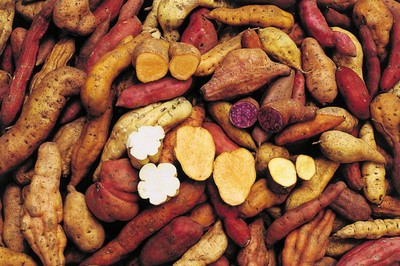
CIP's sweetpotato collection was begun in 1985. The Center's most recent count lists about 6500 samples of sweetpotato, including wild accessions, farmer varieties, and breeding lines. [See also the International Treaty and the CGIAR]. Considered a "small" farmer’s crop, sweetpotatoes grow well in many farming conditions. The crop has relatively few natural enemies—which means that pesticides are rarely used to produce it—and can be grown in poor soils with little fertilizer.

History
Scientists believe that sweetpotato was domesticated more than 5000 years ago. There is still much debate as to just where in the Americas this took place—South America or Central America—although recent evidence suggests that it was the latter. The crop was reportedly introduced into China in the late 16th century. Because of its hardy nature and broad adaptability, and because its planting material can be rapidly multiplied from very few roots, sweetpotato spread through Asia, Africa, and Latin America during the 17th and 18th centuries. It is now grown in more developing countries than any other root crop. [See also: From Latin America to Oceania: The historic dispersal of sweetpotato re-examined using AFLP]

Taxonomy
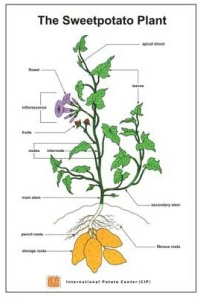
Despite its name, the sweetpotato is not related to the potato. Potatoes are members of the Solanaceae family, which also includes tomatoes, red peppers, and eggplant, while sweetpotatoes belong to the morning-glory family (Convolvulaceae). And unlike the potato—which is a tuber, or thickened stem—the sweetpotato is a storage root.

Origin
Sweetpotato has what botanists call secondary centers of genetic diversity (geographical areas where the crop evolved separately from its American ancestors). In Papua New Guinea and in other parts of Asia, many types of sweetpotato can be found that are genetically distinct from those found in their area of origin. How they reached the Southwest Pacific is open to debate. Some researchers believe European explorers took them there in the wake of the Spanish conquest of Latin America; others favor the idea that long before this, sweetpotato moved from island to island across the Pacific, taken there in boats by indigenous people. Today’s inhabitants of the Pacific islands are among the largest per capita consumers of sweetpotato in the world.

Disaster relief
Sweetpotato has a long history as a lifesaver. The Japanese used it when typhoons demolished their rice fields. Sweetpotato kept millions from starvation in famine-plagued China in the early 1960s, and in Uganda, where a virus ravaged cassava crops in the 1990s, rural communities depended on the sweetpotato to keep hunger at bay.

Nutrition
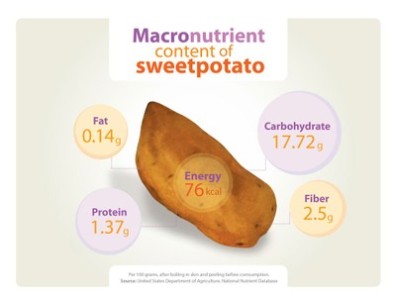
Sweetpotato is high in carbohydrates and vitamin A and can produce more edible energy per hectare per day than wheat, rice or cassava. It has an abundance of uses ranging from consumption of fresh roots or leaves to processing into animal feed, starch, flour, candy, and alcohol.

Global production
Because of its versatility and adaptability, sweetpotato ranks as the world’s seventh most important food crop—after wheat, rice, maize, potato, barley, and cassava. More than 133 million tons are produced globally per year. Asia is the world’s largest sweetpotato-producing region, with 125 million tons of annual production. China—at 117 million tons—accounts for 90 percent of worldwide sweetpotato production. Nearly half of the sweetpotato produced in Asia is used for animal feed, with the remainder primarily used for human consumption, either as fresh or processed products.

In contrast, although African farmers produce only about 7 million tons of sweetpotato annually, most of the crop is cultivated for human consumption. African yields are quite low—about a third of Asian yields—indicating huge potential for future growth.

Facts

  • Six sweetpotato varieties that tolerate salt and drought (Yarada, Nacional, Tacna, Caplina, Atacama, and Costanero) were released by the Universidad Nacional Jorge Basadre from Tacna, Peru, in 1992.
  • Latin America, the original home of the sweetpotato, produces 1.9 million tons of sweetpotato annually. Production in North America is about 600,000 tons. The only European country that produces sizeable quantities of sweetpotato is Portugal, at 23,000 tons.
  • Over 95 percent of the global sweetpotato crop is produced in developing countries, where it is the fifth most important food crop. Sweetpotato is currently grown in more than 100 tropical countries.
  • In the densely populated, semiarid plains of eastern Africa, sweet potato is called cilera abana, "protector of the children." This title alludes to the vital role it fulfills in thousands of villages, where people depend on the crop to combat hunger.